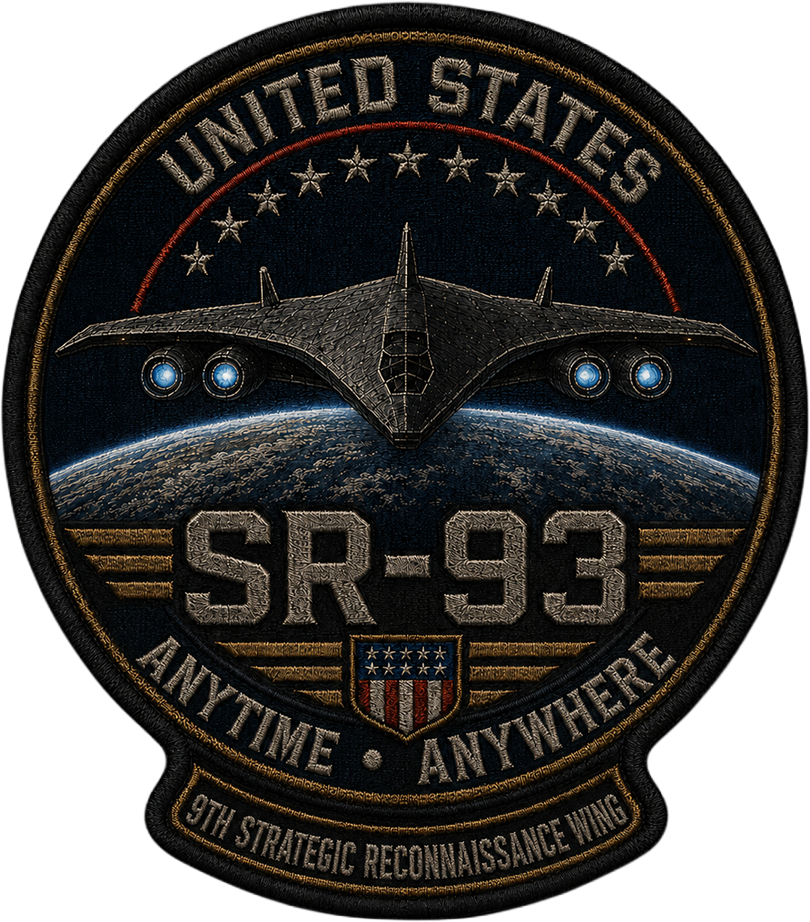
The SR-93 strategic aerospace vehicle in low Earth orbit, a large faceted blended-wing craft with four glowing engine nacelles above a sunlit curve of Earth

United States Strategic Archive · Special Access Aerospace Record

SR-93 Multirole Strategic Aerospace Vehicle

RECORD USA-STRAT-9SRW-93 · SPECIAL ACCESS REQUIRED RESTRICTED

Held under national authority. CROWN access is granted by liaison, not by ownership. Propulsion, thermal-control, and signature-management annexes are withheld at the request of .

Designation
SR-93 multirole strategic aerospace vehicle
Assigned command
9th Strategic Reconnaissance Wing
Nationality
United States
Export status
No foreign release
Mission allocation
National command authority, strategic reconnaissance, global strike, CROWN special operations
Operational status
Active
Numbers built
Unknown. Intelligence estimates suggest a fleet of approximately 300 aircraft, though confirmed sightings account for fewer than half that number.
Wing motto
Anytime • Anywhere
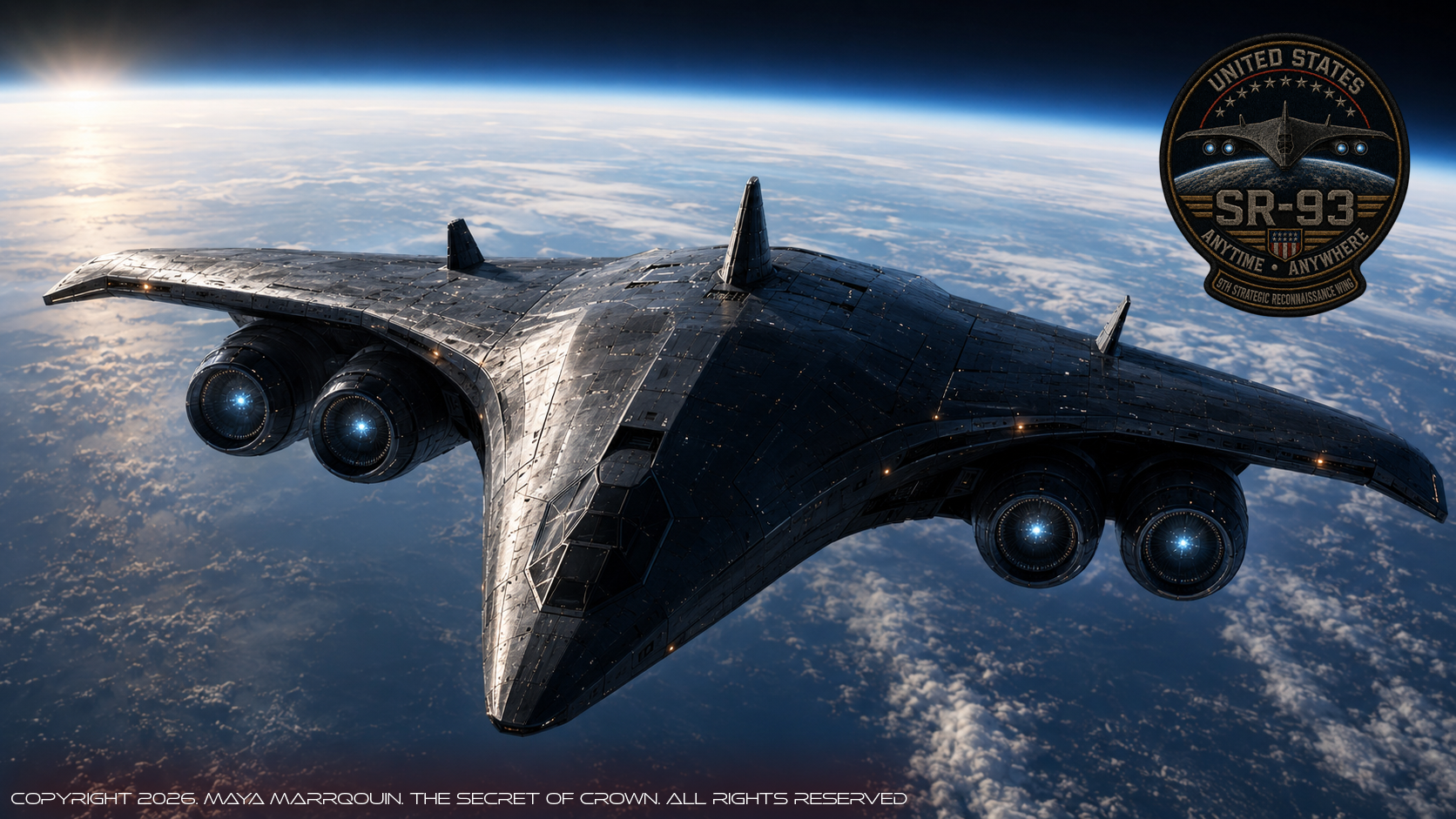
Embroidered 9th Strategic Reconnaissance Wing patch reading United States, SR-93, Anytime Anywhere

The aircraft

The SR-93 is officially classified as a strategic reconnaissance aircraft. That description is accurate in much the same way that calling an aircraft carrier a ship is accurate. It identifies the platform without describing what the platform can do.

It departs from a conventional runway, accelerates through hypersonic flight, crosses the atmosphere along a suborbital trajectory, and enters low Earth orbit when required. Configured appropriately, it remains aloft for weeks conducting reconnaissance, interception, target assessment, or strategic patrol. Then it returns through the atmosphere and lands on a runway.

No other nation is known to possess an operational vehicle with the same combination of speed, endurance, payload, stealth, and mission flexibility.

Though officially described as a strategic reconnaissance platform, the SR-93 is more accurately understood as a reusable heavy-lift spacecraft capable of operating as a bomber, orbital transport, surveillance platform, or weapons-delivery system. CROWN has never disclosed how many exist — or what percentage of them remain airborne at any given time.

Reaching orbit

Space is not especially far away. Orbit is difficult because altitude is only part of the problem. An orbiting vehicle must travel sideways fast enough to continually fall around Earth without striking it — in low orbit, roughly 17,500 miles per hour. The energy required to reach that velocity with a large crewed aircraft, and then dispose of it safely during reentry, is immense. The SR-93 reportedly does both, repeatedly.

Its four adaptive-cycle engines operate as conventional turbines during takeoff, transition to air-breathing hypersonic propulsion at extreme speed, and enter a classified closed-cycle mode beyond the useful atmosphere. Those stages are theoretically understandable. The fuel volume, acceleration profile, thermal behavior, and turnaround time are not.

American officials maintain that the vehicle represents the culmination of more than a century of aerospace development. Foreign services widely assess that its propulsion, thermal, structural, and signature systems incorporate technology derived from the Servator. The United States has never confirmed that assessment. It has never convincingly denied it either.

Annex V — Orbital deburn (video)

Sequence CRN-VID-93-014 — acquired from classified satellite video. Engine flare at the start of an orbital deburn; the vehicle sheds velocity before atmospheric entry. frames withheld.

Modular mission bay

The SR-93 is not permanently configured for any single mission. Its central bay accepts specialiszed modules exchanged before flight. It cannot perform every mission at once; its capability on any given day is whatever the Ninth Wing installed that morning.

Reconnaissance configuration

Orbital sensor suite, autonomous analysis systems, additional power generation, thermal management, and closed-loop life support. Weeks aloft. Optical, infrared, radar, and ultraviolet observation, with onboard analysis comparing new imagery against stored observations and re-tasking the sensors without instruction from the ground. A satellite follows a predictable path; the SR-93 does not.

Special operations configuration

Pressurised team compartment, mission-planning systems, equipment racks, autonomous reconnaissance drones, and life support. The rear compartment is depressurised before insertion and operators exit through the broad aft ramp under HALO or HAHO procedures. At these altitudes a jump system is a small personal spacecraft: oxygen, pressure, heat, navigation, communications, automated recovery. A CROWN insertion team can be placed almost anywhere on Earth within hours.

Arsenal configuration

Multiple Dragon Cart modules — self-contained palletised launch systems that stabilisze, establish position, and deploy after release. A full load is as many as 120 compact guided cruise missiles at roughly 2,000 miles each, separating after deployment and arriving from different directions. The carts also accept electronic-warfare packages, drones, and decoys. The aircraft does not need to fly over a target to decide the battle beneath it.

Strategic configuration

Certified for conventional and atomic payloads. Loadouts are among the most tightly held records in the United States. Unlike a ballistic missile, the vehicle can be launched without committing to an attack: it can hold in the upper atmosphere or in orbit, collect intelligence, receive revised instructions, and return without releasing anything. That flexibility is the point. It is also why other governments cannot sleep.

Orbital kinetic configuration

Never officially acknowledged. Foreign analysts assess guided tungsten penetrators — no explosive, only mass and velocity. Against deeply buried command centers the effect would be real; the city-levelling version belongs to fiction. Guiding a body through reentry plasma is extraordinarily difficult, and whether the problem has been solved is unknown. That governments must assume it has is itself the weapon.

Stealth and signature control

The vehicle's shape and materials produce an extremely small radar return for an aircraft of its size. Foreign tracking stations report occasions when it simply leaves conventional radar entirely. Its performance suggests more than passive stealth: analysts believe it measures incoming radar energy and produces a precisely controlled response that cancels or redirects the returning signal. If true, that is another likely application of Servator-derived work.

Radar invisibility is not invisibility. In space, hiding is hard. Engines produce energy, electronics generate heat, and human beings require a warm pressurised environment. That heat has to go somewhere. Under favorable conditions the SR-93 may still be seen optically or in infrared — provided an observer knows where and when to look, and can separate one vehicle from the immense background of Earth, atmosphere, satellites, debris, and reflected sunlight. By then it has usually changed course.

Defensive systems

The SR-93’s defensive systems remain classified. Available evidence suggests that conventional chaff, flares, and defensive missiles have been replaced by a network of high-energy lasers mounted behind flush optical apertures across the aircraft’s skin.

The system continuously tracks approaching missiles, hostile aircraft, drones, and orbital debris. Once authorized, it can engage multiple targets in rapid succession, damaging guidance sensors, control surfaces, propulsion systems, or structural components. Smaller threats may be destroyed outright. Larger vehicles can be disabled or forced to break pursuit.

Crews refer to the capability as “rapid swatdown.”

Unlike defensive missiles, lasers do not require large ammunition magazines. Their practical limits are electrical power, cooling, atmospheric interference, and the time required to hold sufficient energy on a target. The SR-93’s unusually powerful energy system and unexplained ability to manage heat make directed-energy defense particularly effective aboard the aircraft.

Clouds, dust, atmospheric turbulence, and extreme range can reduce laser performance. At high altitude and in orbit, however, the thinner atmosphere provides a far clearer path to the target. An SR-93 operating above most of the atmosphere may be capable of engaging threats hundreds or even thousands of kilometers away, depending on their size, construction, and relative motion.

Foreign analysts believe its optical system can transition almost instantly between observation, targeting, and defense. The same precision instruments used to study an object from orbit may, when necessary, direct enough energy onto that object to destroy it.

The United States officially describes the system as defensive.

No public explanation has been offered for how it generates, focuses, and dissipates the energy required to engage several targets within seconds.

The Ninth Wing

The 9th Strategic Reconnaissance Wing operates the fleet: pilots, orbital-flight officers, mission commanders, reconnaissance specialists, engineers, loadmasters, life-support technicians, analysts, and the maintenance teams who return one of the most complicated machines ever built to flight status.

CROWN personnel may ride aboard the aircraft. CROWN may request its services. CROWN does not own it.

Every SR-93 remains a strategic asset of the United States. The vehicle has never been exported; requests for allied purchase, licensed production, shared propulsion research, and independent technical inspection have all been denied. That refusal is one of the most persistent sources of tension between the United States and its allies. To Americans, the SR-93 represents security, deterrence, and achievement. To the rest of the world it represents proof that the United States entered the Servator first — and may have kept its most important discoveries for itself.

Known configuration

Crew
Classified; estimated four to six
Mission complement
Up to twenty operators in insertion configuration
Engines
Four adaptive-cycle propulsion units
Maximum speed
Classified. Suspected of reaching approximately 35,000 miles per hour during exoatmospheric flight; not sustainable in the lower atmosphere without catastrophic heating
Atmospheric performance
Hypersonic
Orbital velocity
Approximately 17,500 miles per hour
Orbital endurance
Several weeks with appropriate mission module
Weight
Unknown. Estimated maximum loaded mass of 1.5 to 2 million pounds based on dimensions and internal volume, comparable to the largest 20th-century passenger aircraft
Payload capacity
Classified. Estimates range from 300,000 to 400,000 pounds to low orbit, sufficient for a dozen 25,000-pound kinetic penetrators, multiple SuperDragon payload vehicles, satellites, nuclear weapons, or mixed strategic cargo
Launch and recovery
Reinforced conventional runway
Reconnaissance
Orbital and atmospheric multispectral surveillance
Insertion
HALO, HAHO, and suborbital delivery
Conventional strike
Up to 120 guided cruise missiles via Dragon Cart
Standoff range
Approximately 2,000 miles per cruise missile
Strategic payloads
Conventional and atomic
Orbital kinetic payloads
Unconfirmed
Radar signature
Effectively absent under most operating conditions
Servator-derived systems
Officially denied
Foreign intelligence assessment
Certain

Archival note — the Ninth Wing inherited a tradition built around seeing farther than anyone else. The SR-93 added the ability to arrive there first. This record is not indexed on the CROWN Secure Network and is not listed in the directory of files.