
Enclave tier
Secure estates, private transportation, regenerative medicine, engineered environments, and privileged access to Servator-derived technology.
Humanity survived the war. The world it had built did not.
§ 1 — A tale of two cities
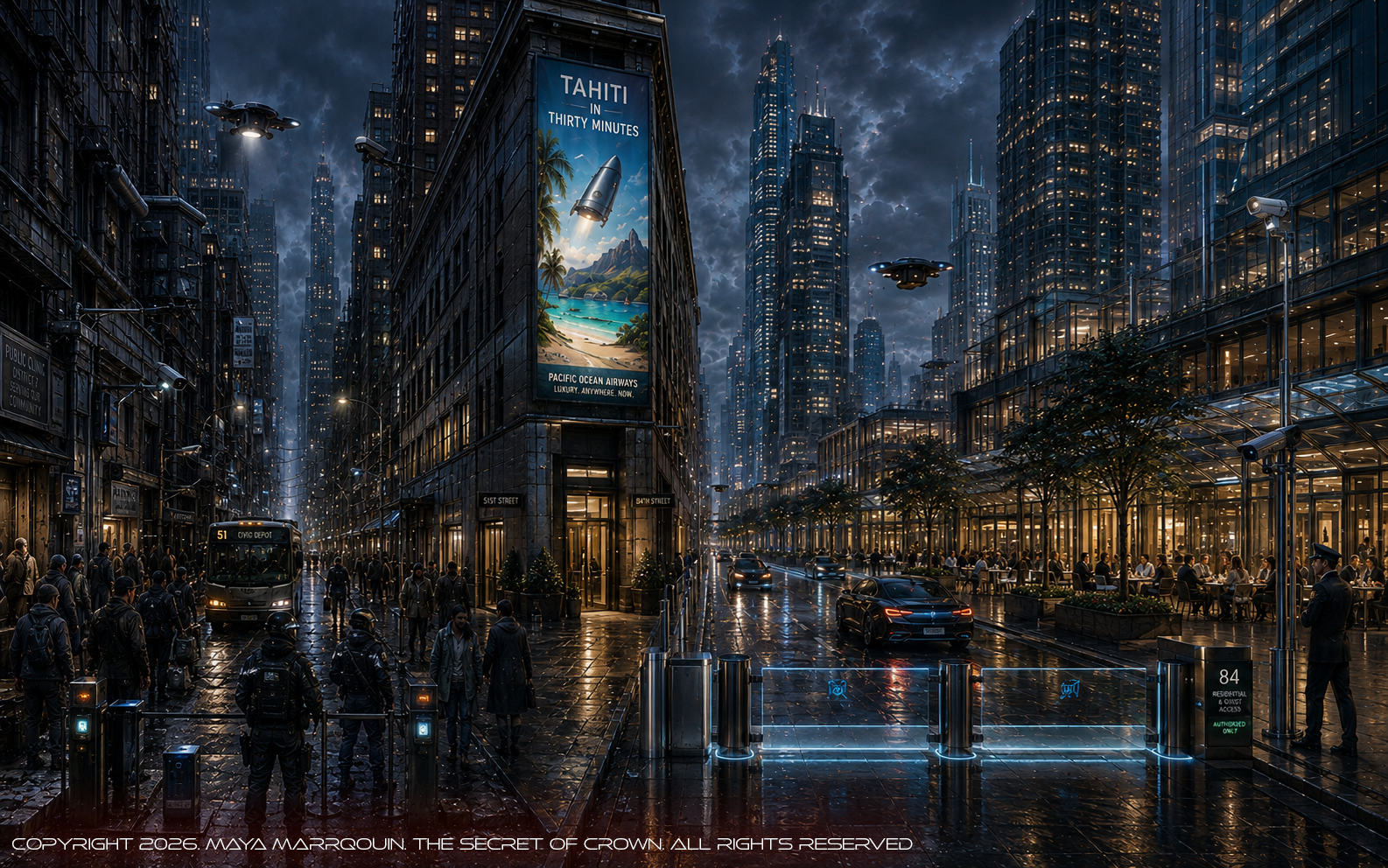
The nuclear war of 2151 did not flatten inequality. It sharpened it. Cities that survived intact became choke points of power. Cities that burned became warnings. Those who controlled food, energy, medicine, and data after the war controlled the terms of reconstruction — and they wrote those terms to protect themselves first.
By 2264, the gap between the protected enclaves and the rest of the world had become a canyon. On one street, automated restaurants serve meals to officials and technicians under warm light. On the next, ration queues form before dawn. Both are legal. Both are monitored. Both are described by the same government reports as evidence of a stable society.
Surveillance, mass control, and concentrated power allowed the oppression to grow exponentially. Faces are read from orbit. Voices are indexed by algorithm. Gait, purchase history, medical records, and social connections are merged into a single citizen profile that follows every person from cradle to disposal. Dissent does not need to be punished if it can be predicted and prevented.
But even the supposed wealthy were not immune.
Wealth in 2264 is not land or gold. It is entries in databases that can be edited by people more powerful than the owner. One changed digit in a credit record, one reclassified security clearance, one altered genetic marker, and a privileged citizen wakes up locked out of transport, housing, medicine, and employment. The fall is fast. The streets do not care who your parents were.
One digit changed. Privileged to struggling. The database does not apologize.
§ 2 — The uneven catastrophe
The nuclear war of 2151 was not the final exchange generations had feared. Had every available weapon launched and every target been destroyed, human civilization might not have survived at all. Instead, the catastrophe unfolded unevenly.
Some arsenals were old. Missiles failed in their silos, guidance systems malfunctioned, and delivery vehicles broke apart before reaching their targets. Some warheads never detonated. Other nations possessed defensive systems capable of intercepting part of an incoming attack. Geography, preparation, obsolete machinery, and chance saved billions of lives.
They did not save the old world.
Most large nations lost one or more major cities. Some lost several. Ports, financial centers, industrial districts, power stations, and transportation hubs disappeared in minutes. Electromagnetic pulses destroyed unprotected electronics and plunged entire regions into darkness. Communications failed. Hospitals exhausted their reserves. Water-treatment plants stopped operating.
The war was not fought with nuclear weapons alone. Desperate governments released engineered influenza strains, agricultural pathogens, insect-borne diseases, and other biological weapons. Some attacks were carefully targeted. Others escaped containment or mutated after release. No government admitted responsibility, and the collapse of international monitoring made attribution nearly impossible.
The first explosions killed millions. What followed killed far more.
§ 3 — Secondary collapse
Modern civilization had produced more food than any previous society, but producing food was only the beginning of feeding people. Industrial agriculture depended on synthetic fertilizers, machinery, irrigation pumps, refrigeration, packaging, fuel, functioning roads, and the labor of millions. When power grids and transportation networks failed, the food system failed with them.
Crops remained in fields because harvesting equipment had no fuel or replacement parts. Milk spoiled in storage tanks. Refrigerated warehouses warmed within days. Trucks carrying food sat abandoned on blocked highways while people starved a few kilometers away. Ports filled with containers no functioning authority could unload. In some regions farmers possessed food but could not move it; in others, cities possessed money that no longer purchased anything.
Smoke and soot disrupted regional climates and shortened growing seasons. Fertilizer factories stopped operating. Engineered crop diseases spread through districts already struggling with radiation, labor shortages, and contaminated water. Livestock were destroyed by disease or slaughtered faster than they could reproduce.
A significant portion of humanity died during the famine and epidemics that followed — plausibly more than died in the detonations themselves.
No official record provides a reliable total. Too many governments had fallen, too many populations were moving, and too many deaths occurred where no one remained to count them.
§ 4 — Recovery
Recovery took generations. Robotic construction systems cleared unstable ruins. Contaminated soil was removed, sealed, or buried beneath engineered foundations. Automated farms expanded across surviving agricultural regions. Fusion, nuclear, solar, and orbital power restored electricity unevenly — first to government and military centers, then to industrial zones, and finally to the wider population.
Food security became the first obligation of every surviving government. High-speed refrigerated railways replaced much of the old trucking system. Grain, produce, medicine, and drinking water could cross continents without relying on thousands of independent vehicles or vulnerable highways. Autonomous machines cultivated enormous farms, managed mines, inspected rail lines, and maintained the infrastructure separating the cities.
The institutions that emerged were rarely the ones that had existed before the war. Northern Africa formed a union that rejected political and economic structures inherited from centuries of foreign rule. Elsewhere, frightened populations moved in the opposite direction: Britain, Australia, New Zealand, and parts of Southern Africa reconstituted the British Monarchy, trading some democratic uncertainty for the promise of continuity and protection.
New coalitions formed around food, energy, security, language, geography, and access to technology. Nations merged. Borders shifted. Governments that had once competed were compelled to share infrastructure simply to keep their populations alive.
Then, twenty years after the war, the Servator Probe arrived.
It did not rebuild Earth. It did not explain itself. But fragments of the knowledge recovered from it transformed materials science, medicine, transportation, energy, and defense. Governments classified the most valuable discoveries. Corporations commercialized what they were permitted to receive. Other technologies escaped through espionage, black markets, and scientists who believed no nation should control them.
Vitanium became the most famous — and most feared — of those discoveries. Its ability to repair tissue and slow some effects of aging created a market no prohibition could eliminate. The wealthy pursued illegal treatments through private clinics and orbital laboratories. Desperate patients accepted risks governments refused to acknowledge. Everyone had heard stories of people who no longer appeared to age. No one knew which stories were true.
§ 5 — Settlement
By 2264, Earth's population has reached approximately fourteen billion. The planet is more crowded than ever, but its population is concentrated rather than distributed. Reconstruction governments blamed suburban expansion for lost farmland, excessive energy use, fragile transportation networks, and environmental destruction. Under the banner of sustainability, most outlawed or severely restricted new suburban development.
The result is a world of immense, densely populated urban centers separated by vast agricultural, industrial, and protected territories. Two-hundred-and-fifty-story mixed-use towers are common. A single building may contain apartments, schools, clinics, stores, offices, factories, gardens, water-treatment systems, and transit stations. Many residents live, work, shop, and attend school without leaving their district.
The wealthiest towers are spacious vertical communities filled with natural light and greenery. Poorer structures are crowded, noisy, and relentlessly regulated. In less prosperous cities, human workers still staff factories where specialized robots, maintenance contracts, or automated production licenses cost more than adaptable human labor. Life in those districts can be harsh.
Outside the cities, the world feels almost empty. Automated farms extend to the horizon. Mining machines operate in territories where few people permanently live. Enormous high-speed rail corridors connect urban regions, carrying passengers in one direction and refrigerated food in the other.
Private automobiles have nearly disappeared from most cities; governments describe them as inefficient uses of energy and public space. At airports and suborbital terminals, authorized autonomous cars wait to carry passengers into restricted estates, research centers, military facilities, and rural districts. For everyone else, the train is mandatory.
§ 6 — Economy
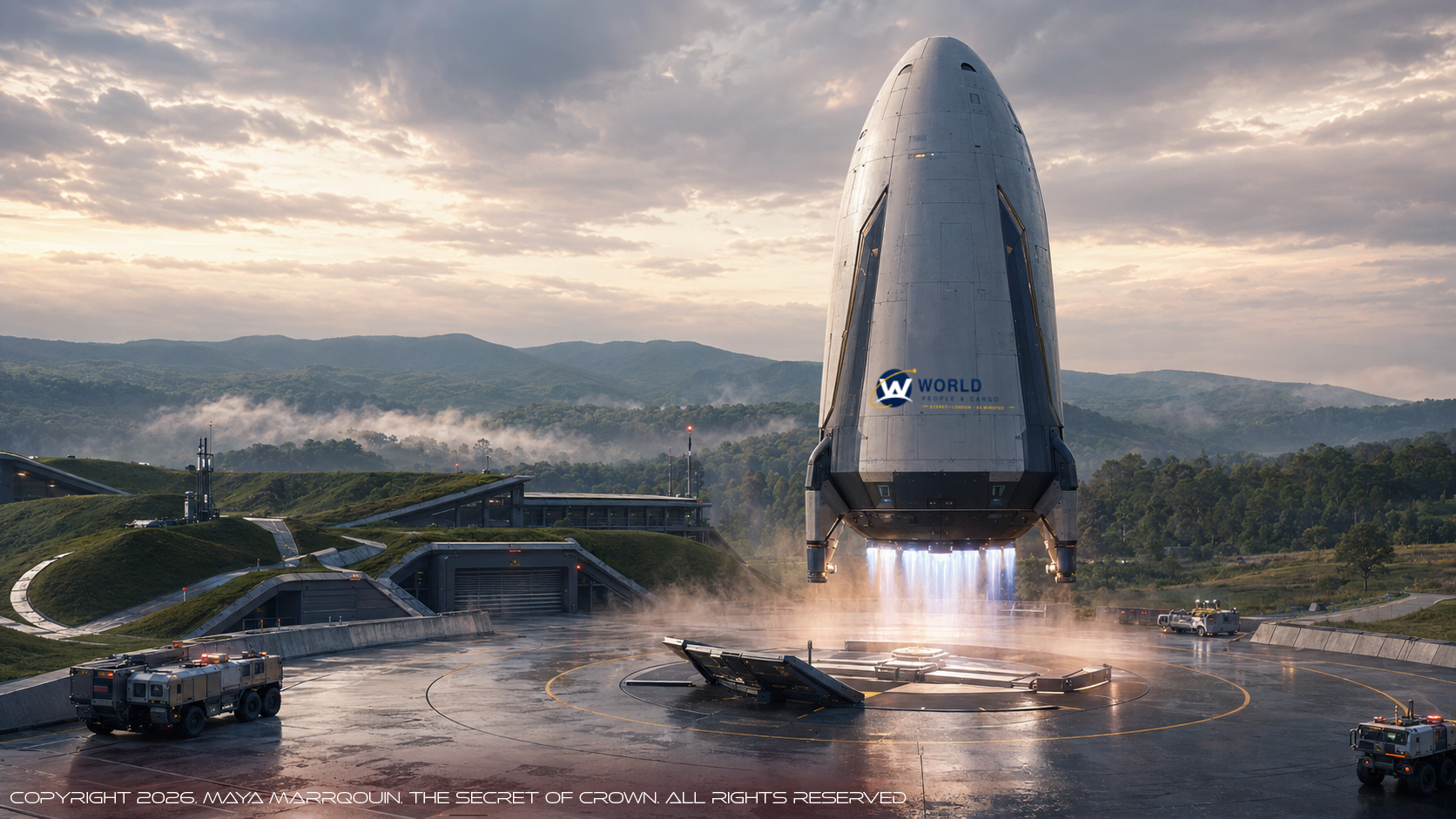
Commerce flourishes within this system. Suborbital transports carry passengers between continents in less than an hour. Automated cargo networks deliver medicine, machine components, and extremely valuable goods across the planet. Advanced manufacturing has lowered the cost of food, clothing, energy, and basic shelter. The poorest citizens are generally better fed and medically supported than their counterparts two centuries earlier.
But prosperity is not evenly shared.
Secure estates, private transportation, regenerative medicine, engineered environments, and privileged access to Servator-derived technology.
Engineers, pilots, physicians, programmers, fabricators, reactor technicians, and the skilled trades that keep an extraordinarily complex civilization running.
Safe, fed, medically supported — according to the governments that publish the measures. When the figures contradict the narrative, the figures are revised. Little accumulated wealth, limited physical mobility, and almost no influence over the institutions governing them.
Largely absent from the record. The category survives in law and statistics more than in life.
The future is comfortable for many. It is free for far fewer.
§ 7 — Medicine and its limits
Regenerative medicine and Servator-derived therapies have transformed human health — for those who can pay. The wealthy do not merely treat disease; they purchase longer youth, sharper cognition, and resistance to injuries that would disable an ordinary patient. Some enclave families openly enhance their children before birth: improved metabolism, accelerated healing, resistance to common pathogens, traits once considered science fiction now treated as another inheritance from a privileged parent.
The general population is told it receives the same standard of care. The claim is difficult to verify. Governments control the health statistics, and when the numbers conflict with official narratives, the numbers are quietly corrected.
In poorer districts, diseases eradicated in earlier centuries have reappeared. Tuberculosis, polio, cholera, and even smallpox surface in overcrowded towers and neglected agricultural zones. Authorities attribute them to migration, contaminated infrastructure, or unlicensed genetic treatments. Some physicians believe they are simply not being cured. A curable illness in a poor patient is often managed with comfort care and hospice rather than the therapies that would restore them. It is cheaper, and it is quieter.
The old are eased out of the numbers. The sick are reclassified as terminal. And the public is reassured that medicine has never been better.
Beneath the official record, stranger rumors persist. Intelligence analysts and investigative journalists speak of programs that do not appear in any budget: amoral genetic manipulation designed to produce operatives who are smarter, faster, and stronger than any baseline human. The subjects are variously described as volunteers, prisoners, orphans, or simply missing. No government admits to creating supersoldiers. No government has explained why so many young adults with no legal history vanish from the lowest census tiers.
The future is comfortable for many. For the rest, it is managed, measured, and, when necessary, removed from the count.
§ 8 — Governance
The governments of 2264 were created by people who remembered what disorder had cost. Surveillance is nearly universal. Public spaces recognize faces, voices, movement patterns, and biological signatures. Artificial intelligences search communications for threats before human analysts ever see them. Political organizations are monitored from the moment they form. Informants and government operatives routinely infiltrate opposition groups in the name of preventing extremism.
Official crime statistics are treated with the same skepticism as economic figures. A killing is not recorded as murder until a suspect has been apprehended and convicted, so unsolved homicides vanish from the count. Handguns are heavily regulated and comparatively rare, but knife violence is common and frequently reclassified as accident, misadventure, or self-inflicted injury. Battery against ordinary citizens is generally charged as a misdemeanor, if it is charged at all. Police are scarce in most districts; to encounter an officer usually means someone with influence has decided you are worth the paperwork. In many municipalities they function as a protected guild, shielded from consequences and quietly available to those who can pay for their attention. The brutality of enforcement varies widely by state, but the pattern is consistent: the law is a service for the powerful, not a protection for everyone else.
Literature is regulated. Some governments prohibit novels such as 1984 and Fahrenheit 451, describing them as relics used to encourage distrust of necessary institutions. Other works disappear under laws banning extremist propaganda, hateful symbols, dangerous historical material, destabilizing misinformation, or antisocial ideology. The categories expand whenever authorities find them useful.
Citizens who organize resistance may lose employment, housing priority, travel privileges, educational access, or even legal identity. Those classified as serious threats simply disappear.
Most governments do not describe these actions as oppression. They call them prevention.
Their citizens are protected from famine, disease, terrorism, and much of the ordinary violence that once shaped human life. Streets are clean. Transportation is fast. Medicine performs what earlier generations would have considered miracles. Propaganda reminds the public that none of these achievements would exist without order.
Increasingly, people are asking what that order has cost. Some governments resent America's control of the Servator site. Others fear CROWN's growing military and technological power. Citizens resent being watched by institutions that claim surveillance keeps them free. Coalitions that cooperate publicly conduct espionage against one another in private. Beneath the prosperity, old grievances are returning in new forms.
§ 8 — Reference
Archival note — Earth in 2264 is not a wasteland. It is a planet of brilliant vertical cities, silent automated countryside, miraculous medicine, and fourteen billion human beings living under institutions so afraid of civilization's past that they have made freedom itself a security risk.