
Science & learning
The Evidence Archive
Begin with the child's question. Use the disciplines to investigate it. Use the four evidence categories to show where the answer stands.
Children are natural investigators. This archive does not open with a subject heading — it opens with a question a young reader might actually ask, and then uses whichever disciplines are needed to chase it down.
Start with a question
Investigations
Biology · History · Ethics · Literature
CROWN describes the Kings as enhanced, protected, and prepared. They could not consent to changes made before they were born, and their abilities were selected to serve someone else's purposes.
Physics · Measurement · Philosophy of science
A sphere holds its position above the Nooitgedacht Protectorate. Nothing exhausts. Nothing spins. Everything we know about staying up involves pushing something down.
Biology · Cognition · Philosophy
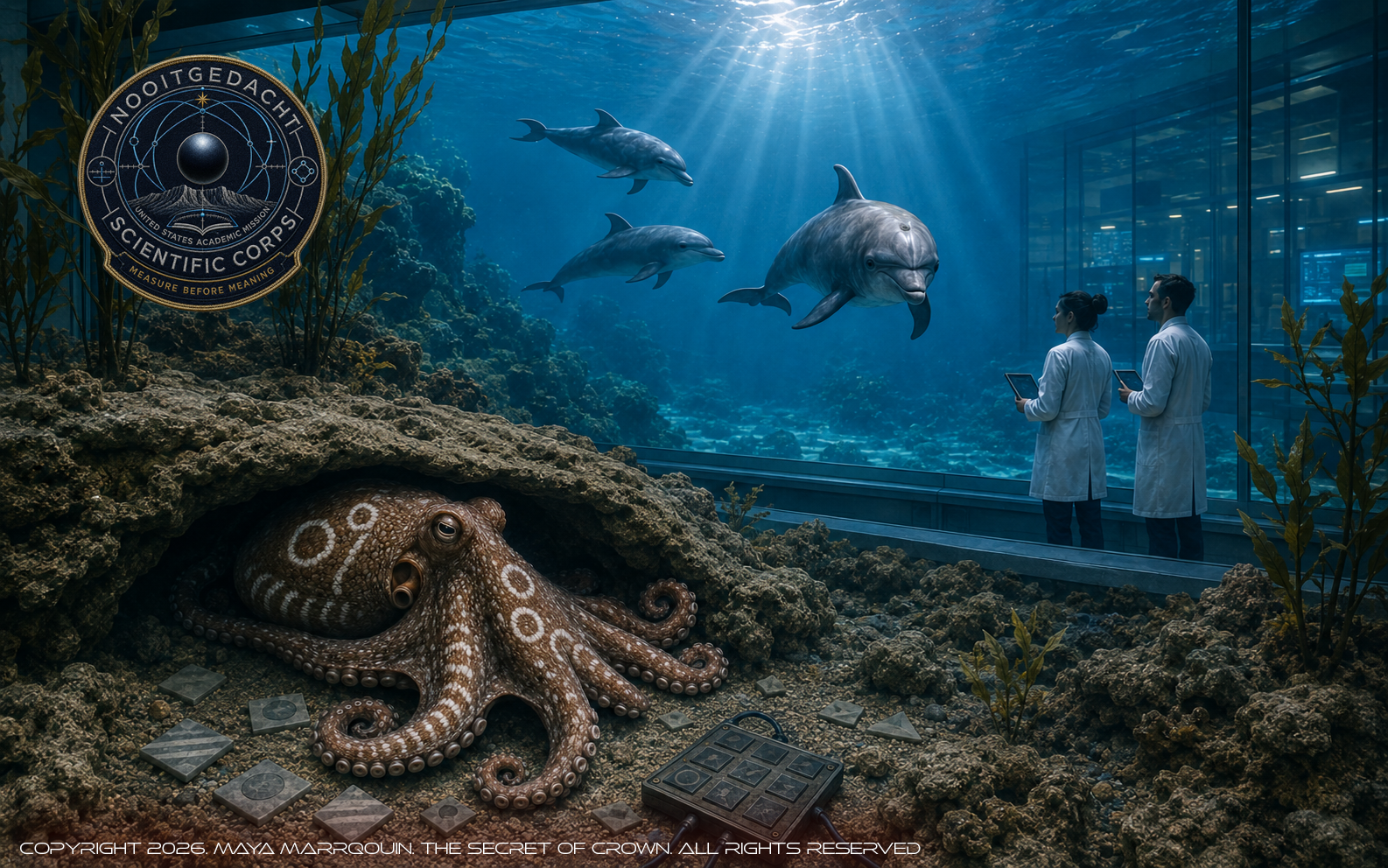
Every intelligence test humans have built rewards being like us. That is a problem for octopuses and dolphins. It is a much bigger problem for something that came from somewhere else.
Astronomy · Statistics · Astrobiology
The galaxy is enormous, old, and mostly quiet. Two equations frame the problem from opposite directions, and neither of them gives an answer — they organize the ignorance.
Astrobiology · Ecology · Literary criticism
Invasion stories nearly always give aliens a human motive: resources, conquest, hunger, salvation. The Servator has not offered one, and ninety-three years of guessing may say more about us than about it.
Civics · History
Governments rarely announce that freedom has ended. Citizens hand over a little authority during an emergency because the danger is real — and then the emergency passes and the powers do not.
Civics · Ethics · Cognition
The Servator asked for ten representatives. It did not say representatives of what — and no election has ever been held for the position.
Physics · Epistemology · Measurement
The probe is nearly silent across the radio spectrum. It has still been yielding information for ninety-three years, because science is observation, and careful observation keeps taking more out of an object than it appeared to hold.
How to read this archive
Four labels
Established Knowledge
Supported by current evidence and testable today.
Plausible Extrapolation
A reasonable extension of developing science.
Servator-Enabled
Theoretically discussable but beyond human engineering.
Speculative Fiction
Where the story has moved past testable knowledge and plausible prediction. Not a weakness — a boundary marked honestly.
The four categories are labels of intellectual honesty, not a ladder running from good down to bad. Speculative fiction is not a failure of the science. It is the point at which the story admits it has left the map, and saying so out loud is the most scientific move on the page.
The whole archive
Two other doors
37 articles
Browse by subject →
Genetics, life and intelligence, finding alien life, measurement, models, physics, and alien motives — the full index, grouped by discipline.
Civic principle · Historical pattern · Fictional extrapolation · Open question
Civics Under Pressure →
Legitimacy, emergency powers, the rule of law, official secrecy, who owns the Probe, and who has the right to speak for Earth. Includes the Constitutional Stress Test.
For classrooms
Using these pages in teaching
Switch on the educator view and every investigation reveals its teaching layer: essential question, estimated time, reading order with reasons, prompts by difficulty, a classroom activity, and common misconceptions. The setting follows you from page to page.